How We Treat Your Water
From Lake Sinclair to your tap — a plain-language walkthrough of the ten steps that turn raw lake water into safe drinking water.
From Lake Sinclair to Your Tap
All drinking water produced by the Sinclair Water Treatment Facility begins at Lake Sinclair — a 15,330-acre reservoir on the Oconee River. Raw water drawn from the lake passes through ten treatment steps before entering the distribution system as safe, finished drinking water that meets all federal and Georgia standards.

Ten Steps to Safe Drinking Water
Each step removes something specific — sediment, organic matter, pathogens, or other naturally occurring materials — building layer upon layer of protection before water leaves the plant.
Raw Water Intake
Water is drawn from Lake Sinclair at an intake located approximately 860 feet offshore, in deep water. Stainless steel intake screens prevent leaves, debris, and other large material from entering the system.
Pre-Oxidation
Before the water is pumped to the plant, a small dose of oxidizing chemical is added. This begins removing dissolved iron, manganese, and organic compounds that occur naturally in the lake water.
Transmission
Four pumps move the water through a 24-inch underground pipeline — nearly three-quarters of a mile — to the main treatment plant on Cay Drive in Milledgeville.
Rapid Mixing
At the plant, a coagulant (alum) is added and instantly mixed into the water. This causes tiny suspended particles — clay, sediment, and microscopic material — to begin clumping together in preparation for removal.
Flocculation
The water flows slowly through three concrete basins over approximately 30 minutes. Gentle mixing causes the clumped particles to combine into larger, heavier masses called "floc" — visible to the naked eye, resembling floating snowflakes.
Sedimentation
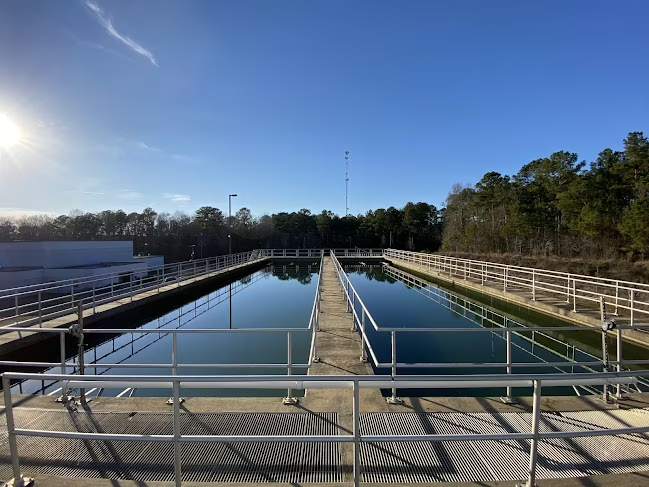
The water enters two large settling basins where gravity pulls the heavy floc to the bottom. The settled solids are collected and sent to on-site lagoons for safe disposal.
Straining
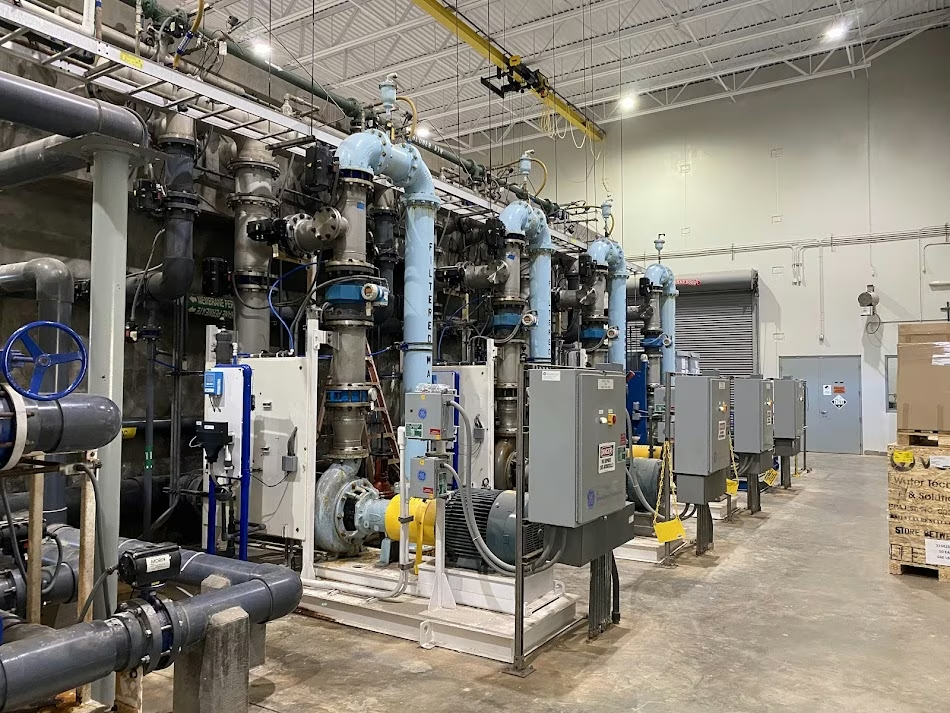
Before entering the membrane system, the water passes through stainless steel basket strainers that catch any remaining debris — pine needles, leaves, or fine particles — protecting the membranes downstream.
Membrane Filtration
The water is filtered through four trains of ZeeWeed® ultrafiltration membranes. Each membrane is a hollow fibre with pores just 0.02 microns in diameter — far too small for bacteria, viruses, Giardia, or Cryptosporidium to pass through. This is a physical barrier, not just a chemical one. The system is integrity-tested every 24 hours.
Post-Treatment
After filtration, the water receives final chemical treatment: pH adjustment, corrosion control, fluoride for dental health, and a small dose of sodium hypochlorite to maintain disinfection residual throughout the distribution system.
Storage and Distribution
Finished water is stored in a 2-million-gallon clearwell on site and pumped through separate high-service distribution mains to Baldwin County and Putnam County customers.
How Membrane Filtration Protects Your Water
Step 8 — membrane filtration — is the most critical barrier in the treatment process. Here is what it does, why it matters, and how we verify it is working at all times.
What the membranes do
The facility uses ZeeWeed® ultrafiltration membrane technology. Each membrane is a hollow fibre — thousands of fibres bundled together into modules — and each fibre is perforated with pores just 0.02 microns across. Water passes through those pores; pathogens do not. It is a physical barrier, not just a chemical treatment, which means no organism large enough to cause disease can pass through an intact membrane.
Size comparison: membrane pore vs. common pathogens
| Particle or organism | Approximate size | Passes through membrane? |
|---|---|---|
| Human hair | ~70 microns | No |
| Giardia (parasite) | 4–14 microns | No |
| Cryptosporidium (parasite) | 4–6 microns | No |
| Typical bacterium | 0.5–5 microns | No |
| Membrane pore (ZeeWeed®) | 0.02 microns | Water molecules only |
Scale of the system
How we verify it is working
Every 24 hours, each membrane train undergoes direct integrity testing to confirm there are no breaches in the membrane barrier. If a breach were ever detected, the affected train would be taken offline for inspection and repair before being returned to service.
The clarity (turbidity) of filtered water is also monitored continuously — readings are taken every 15 minutes, around the clock. The facility's operating permit requires turbidity to remain below 0.10 NTU in at least 95% of monthly readings. Monthly operational records are submitted to Georgia EPD.
Review Our Water Quality Reports
Every year, we publish a Consumer Confidence Report — a plain-language summary of every contaminant monitored, how detected levels compare to federal standards, and where your water comes from.